

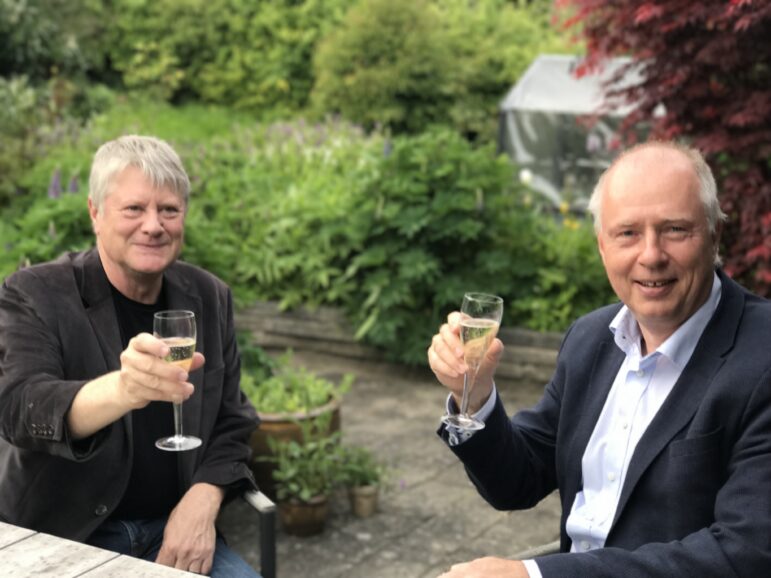
Brant Houston and Nils Mulvad in 2017 celebrating 16 years of 1st conference. Photo: Lone Hougaard
In April 2001 I stood on a stage at Hotel D’Angleterre in Copenhagen and promised several hundred strangers that we would do it again. It was not planned. There were about 400 investigative journalists from some 40 countries in the room.
The mood was unlike anything I had experienced before or have experienced since. I had no budget, no board and no plan for how an “again” would be financed. I had seen that the need was far greater than any of us had expected.
The conference was a collaboration between the small Danish institute DICAR, which I headed, the Danish Association for Investigative Journalism, FUJ (Foreningen for Undersøgende Journalistik), and the American organization Investigative Reporters and Editors, IRE.
The idea had come from Brant Houston, then director of IRE, the year before. The three organizations carried the first two conferences. Two years later, at the second conference in Copenhagen, the Global Investigative Journalism Network, GIJN, was formally founded.
The conferences rested on a few ideas that we have never changed: That investigative journalists should work together across borders. That methods should be shared and developed together. That structured data work is a central part of quality journalism and not a niche. And that practicing journalism, education and research should develop together.
Today, 25 years on, we mark the anniversary with a virtual panel, where I take part together with Brant Houston and others who have shaped the network. GIJN is now a network of more than 260 member organizations in about 95 countries, led since 2023 by Emilia Díaz-Struck. It is easy to tell that story as if it were inevitable. It was not.
We knew the need was there. But turning a successful meeting into a lasting, global institution is something else entirely. It took more than a decade before GIJN got a secretariat, in 2012, and until then personal trust held it all together, not least the collaboration between Brant Houston and me.
When we wanted to build a secretariat and a board, we met resistance. Some feared that they would gain too much influence and gather funding that had previously gone to the national organizations. Others feared that a board would be dominated by Europeans and Americans. The alternative was to carry on as an informal network, run in practice by Brant and me, and that had no future.
We spent about a year in dialogue and designed election procedures that secured good representation from the parts of the world that then had the least investigative journalism, especially Africa and Asia. Then we persuaded the skeptics to start a secretariat as a trial arrangement. When we decided to elect a board, only a few were opposed, so the decision had broad acceptance.
GIJN is not the only international cooperation that Danish journalists have helped build. International Media Support, which helps keep journalism and media alive in conflict zones, was founded before the network and is still active. Scoop, a programme that began shortly after the first global conference, supported investigative journalism in Southeastern Europe and Ukraine, and was later one of the hosts of the global conference in 2011. Farmsubsidy.org, which I helped start in 2005, became the beginning of Dataharvest, the joint European conference for investigative journalism and data journalism.
Danwatch works with journalists in developing countries to bring stories about the downside of cheap goods into Danish media, and Gravercentret supports local investigative journalism. In the large international networks such as ICIJ, Danish participants are very active. It is a success story about Danish journalists helping to create a well-functioning international cooperation. It is worth remembering now that the network turns 25.
Not everything we built has lasted. DICAR closed in 2007, after four different routes to continued funding all proved impossible. Scoop and Farmsubsidy.org also stopped in time. It was not because the need was gone but because the grants ran out, and that can happen to the best initiatives. There is no guarantee, and it is very hard to run this kind of work without some form of funding.
These years there is generally less of it, and it hits both international cooperation and local investigative projects and centers. Some are lucky and get onto the Danish national budget (the Finance Act), as Danwatch and Gravercentret have, and are protected for a while. But a new media agreement between the political parties may stop supporting them, and without another way of bringing in funding they are exposed.
It can hit GIJN too. I do not think it will, but when something loses its funding or gets very little, there come times when you must decide to close down instead of continuing. That is hard, and we must learn it. Investigative journalists are stubborn, and that is a strength, but it can also make us hold on for too long. It was right to close DICAR, but it did not feel obviously right when the decision had to be made.
But what I am happiest about in the network is how it has changed. In the early years it was largely middle-aged white men from the US and Europe who sat on the panels and led the training in data journalism methods. Today the presenters are young and old, men and women, from every part of the world, both on data methods and on methods in investigative journalism.
Knowledge now moves in every direction. Diversification is a terrible word, but here it has worked in practice. Young journalists pour in from all over the world to the global conferences, which are held every two years, and they are keen to work this way. It is a great joy to have helped set it in motion.
It was not a given that the promise made from the stage at Hotel D’Angleterre in 2001 would hold for 25 years. It did.
Nils Mulvad is a journalist and co-founder of Kaas & Mulvad. He was the main organizer of the first two global conferences for investigative journalism in Copenhagen, in 2001 and 2003.
No comments yet.